What is revision rhinoplasty?
Revision rhinoplasty is a second (sometimes third) operation to correct problems with appearance or breathing in someone who has already had nose surgery. A previously operated nose contains scar tissue, may have less cartilage support and has a different blood supply. For these reasons a revision needs a more detailed assessment and more careful planning than a first rhinoplasty.
The need for revision is not only about how the first operation was done. Individual tissue characteristics, the way you heal, injuries after surgery and changes over time can all play a role. The aim is to find the true source of the problem and plan a solution for it.
Common reasons for seeking a revision
Patients considering revision often describe:
- Nasal blockage that started or worsened after surgery
- A residual hump, irregularities on the bridge, or a collapse from over-reduction
- A drooping, over-rotated or asymmetric tip
- A nose that still leans to one side
- Nostril walls that collapse inwards on breathing in
- A tip that feels stiff, looks shapeless or different from what was expected
Does every concern need surgery?
No. In the first months after surgery the nose is still swollen and its shape keeps changing; some irregularities seen at this stage settle on their own. For this reason it is generally recommended to wait at least a year after the first operation so the tissues can settle and swelling can resolve.
For small contour irregularities, non-surgical options such as filler may be considered, although filler in a previously operated nose requires careful judgement. For breathing complaints, non-surgical causes such as allergy or enlarged turbinates are investigated first. If there is a significant breathing problem, the waiting period is assessed individually by the surgeon.
Consultation and planning
A revision consultation takes longer than a first one. Your concerns and goals are discussed in detail, and the outside and inside of the nose are examined to assess the septum, how much cartilage remains, scar tissue and skin thickness.
Photographs are taken from at least seven angles. The discharge summary or operative report from your first surgery, your pre-operative photos and any scans make an important contribution to planning. You can send these via WhatsApp before your visit.
In revision surgery the goal is usually not flawless symmetry, but a balanced, healthy nose that resolves your complaint. Agreeing a realistic goal together is the most important part of the process, and a second consultation can be arranged before you decide.
How the operation is performed
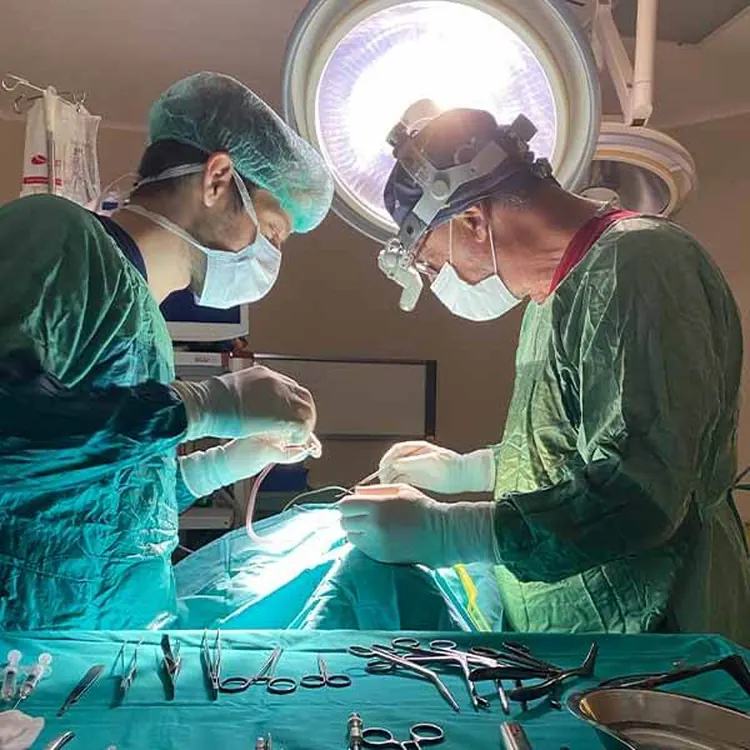
Revision rhinoplasty is performed under general anaesthesia at Medical Park Antalya Hospital. Its length depends on what needs to be done and is often longer than a first rhinoplasty; the expected duration is set after examination and planning.
Dr. Karataş generally prefers the open technique for revisions as well. It allows previously altered structures and scar tissue to be seen directly and reshaped.
If cartilage support was reduced in the first operation, your own cartilage may be needed to rebuild support. Septal cartilage is used first; if not enough remains, ear or rib cartilage may be considered. Which tissue is used is discussed during examination and planning.
If there is a breathing problem, the septum and turbinates are addressed in the same operation. Discharge and length of stay are explained in advance according to the extent of surgery.
Recovery timeline
Because of scar tissue, recovery after revision can take longer than after a first operation. The timeline below is a general guide.
- Day 1Swelling around the nose and eyes, some oozing and blockage are expected. Rest with your head raised; pain is controlled with prescribed medication. If cartilage was taken from another site, that area may also be tender.
- Week 1Bruising and swelling begin to settle after the first days. The external splint is usually removed at the follow-up visit around the end of the first week.
- Weeks 2–3Most bruising fades and you begin returning to daily life. The nose may still be noticeably swollen.
- Months 1–3Swelling continues to reduce; the tip may feel firm. You will be advised at follow-up about sport and wearing glasses.
- Months 6–12 and beyondThe nose gradually reaches its final shape. After revision this can take more than a year; the final assessment is usually made once swelling has fully resolved.
Risks and how they are managed
The risks of revision rhinoplasty are similar to those of a first operation, but some may be more pronounced because the tissues have been operated on before:
- Prolonged swelling and bruising
- Bleeding and infection
- Reduced sensation or numbness at the tip
- Asymmetry or a result that does not fully meet expectations
- Persistent breathing problems
- Discomfort at a cartilage donor site
- Rarely, the need for a further correction
Reducing the risks
A detailed assessment of the previous surgery and the current tissues, waiting long enough for the tissues to settle, planning breathing function alongside appearance, and following aftercare instructions all help reduce risk. Smoking can impair healing in tissues whose blood supply has already changed, so stopping before and after surgery is recommended.
Attending follow-up visits regularly is also important. Swelling, internal healing and any cartilage donor site are monitored at these visits; if you have unexpected pain, increasing bleeding, fever or difficulty breathing, contact your surgeon without waiting for the next appointment. Patience matters in revision: the final result is judged only after swelling has fully settled.
Dr. Karataş’s approach
As an ENT surgeon, Op. Dr. Hasan Karataş assesses revision cases by looking at appearance and breathing together. He has worked at hospitals in Antalya since 2007 and has seen patients at Medical Park Antalya since 2017.
In revision cases the first step is to understand where the problem comes from. Whether surgery is needed, when it should be done and what its limits are are discussed openly. If a non-surgical route or waiting is more appropriate, the patient is told so.
Frequently asked questions
How long after my first surgery can a revision be done?
My first operation was done by another surgeon. Can I still be seen?
Will rib cartilage be needed?
Does revision surgery take longer than the first operation?
Is recovery slower after revision?
Do I need a revision just for a breathing problem?
The information on this page is for general guidance only; an examination is required for diagnosis and treatment. Results vary from person to person.